


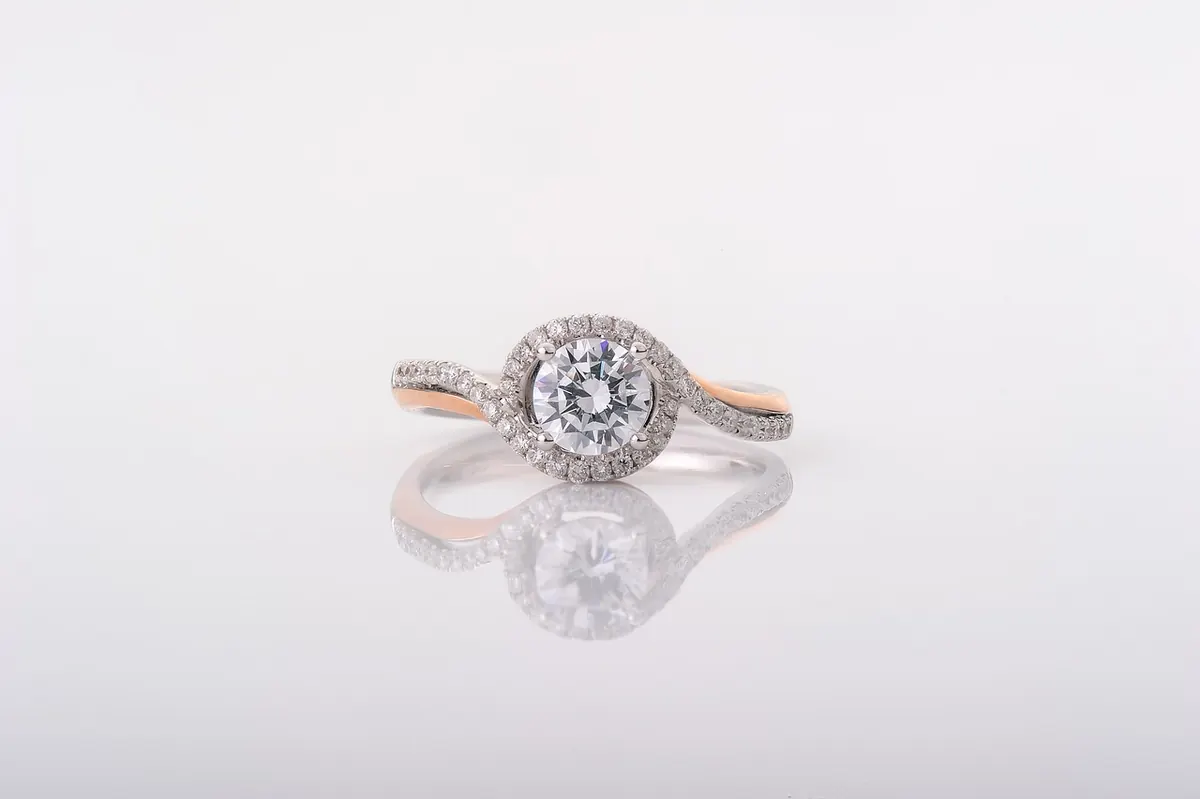
An opal ring on its own asks for attention. Three of them, plus a couple of plain bands, can look like a collection rather than a composition — or like a small accident waiting to happen. The difference is rarely about taste. It comes down to order, proportion, and a few practical decisions made before anything goes on the finger. Opal is softer than most of the stones people stack it with, and a domed cabochon sits higher off the hand than a flat band. The stack you build has to protect the opal as well as show it off.
Know What You Are Stacking
Opal sits at roughly 5.5 to 6.5 on the Mohs scale. That is soft enough to be scratched by household dust, which often contains quartz at around 7, and easily abraded by a diamond eternity band at 10. The metals most rings are made from — sterling silver, 14k and 18k gold — are softer still, around 2.5 to 3, so a gold band will not scratch an opal in normal wear. The opal is far more likely to damage the band than the other way round. The real danger in a stack is a harder gemstone pressing and sliding against the opal's surface, day after day.
Setting matters as much as stone. A bezel wraps the edge of the opal in metal and takes most of the knocks itself; a prong setting leaves the rim exposed. A low cabochon with a shallow dome sits closer to the finger and interferes less with its neighbours. If the opal is a doublet or triplet — a thin slice of opal bonded to a backing, sometimes with a clear cap — treat the edges with extra care, since the bond lines are the vulnerable part. A capped triplet is more resistant to abrasion on the face but still dislikes knocks on the side.
Start With a Plain Band as the Foundation
Plain bands are the scaffolding of a good stack. They give the eye somewhere to rest between decorative rings, they add width without adding visual noise, and they act as buffers between stones. For an opal, aim for bands of about 1.2mm to 1.8mm. Anything much wider starts to compete, and anything much thinner tends to twist and wear unevenly when pressed against a heavier ring.
Look for bands with softened, rounded edges rather than sharp square profiles. Two rounded edges meeting will rub against each other gently; two crisp corners will grind. If your opal ring has a high dome, a contoured or curved band that dips around the setting will sit flush against it instead of leaving a gap that catches on sleeves and hair.
Build the Stack in Order
A stack is easier to get right when you add one element at a time and check it as you go. Work through this sequence on a flat surface, then on the hand.
- Size for the whole stack, not one ring. Three 2mm bands occupy roughly the same space as one 6mm band, but they behave differently on the finger. A stack that is tight enough to leave marks is too tight. If you are commissioning a set, have the finger measured with the intended total width in mind.
- Place the opal first. Decide its position before anything else. The middle of a stack is the safest spot, because plain bands on both sides take the knocks and keep harder rings at a distance.
- Add a plain band on each side. These are your spacers. They should sit flush, with no rocking and no visible gap at the contact points.
- Add rings of similar hardness outward. A second opal, a pearl, a moonstone or a plain band can sit next to the spacers. Diamonds, sapphires, rubies and quartz-based stones should not.
- Check the contact points. Run a fingernail between the rings. If they pinch, catch, or overlap, the widths are mismatched. Prongs are the usual culprit — a claw from one ring hooking under a claw from another.
- Wear it for a day before buying more. How a stack feels after eight hours of typing, driving and washing hands tells you more than a mirror does.
Protecting the Opal Inside the Stack
Most of the damage done to stacked opals happens gradually and invisibly: a faint dulling of the polish, a small chip on a rim, a hairline at the edge of a doublet. A few habits prevent nearly all of it.
- Keep hard stones out of the rings directly touching the opal. If you love a diamond band, put it at the outer edge of the stack, with a spacer between it and the opal.
- Choose bezels over prongs for an opal that will live in a stack. Metal takes the wear instead of the stone.
- Wear the opal ring on the hand you use less. The dominant hand absorbs door frames, shopping bags and car doors.
- Take the stack off for gardening, cleaning, the gym and any task involving grip and impact.
- Store the rings separately, or at least put the opal in a soft pouch inside the box. An opal rattling against a diamond for months in a jewellery tray will come out duller than it went in.
Proportion: Filling the Hand Without Crowding It
The most common stacking mistake is not a clash of metals or colours — it is volume. Four rings on one finger can look deliberate on a long hand and cluttered on a shorter one. A useful rule is to keep the combined width of a single stack at about 10mm to 14mm, and to leave at least one adjacent finger bare. Your eye needs the gap to read the stack as a single gesture.
Long fingers, short fingers
Long fingers carry wider stacks and bolder cabs well. Shorter fingers tend to look best with two or three narrow rings concentrated near the base of the finger, rather than a tall column running up to the knuckle. If the opal is large — say 10mm by 8mm — let it be the only stone in that stack and give it one plain band on either side.
Across the hand
You do not need to stack every finger. Try a full stack on the ring finger, a single thin band on the middle finger and nothing on the index finger. That rhythm looks intentional; three stacked fingers in a row looks accidental. If you wear a stack on the index finger, keep it low-profile — that finger catches on everything.
Mixing Metals and Textures
Two metals in one stack is a style choice; three usually reads as clutter. Warm gold next to silver works when the opal contains both tones — many do, which is one of the quiet advantages of the stone. Match the finish, too: an all-polished stack looks cohesive, an all-brushed stack looks modern, and mixing the two works only if you repeat the pattern so it looks deliberate rather than leftover.
Let the opal stay the loudest element. If the stone has strong play of colour, keep the bands plain. If the opal is pale or milky, a textured band — hammered, twisted, milgrain — adds interest without fighting the stone for attention.
Living With the Stack: Care and Cleaning
Opal holds water within its structure, and that shapes how you care for it. Clean the rings with a soft damp cloth and mild soap, rinse briefly and dry immediately with a lint-free cloth. Do not soak an opal ring, do not put it in an ultrasonic cleaner, and keep it away from bleach, ammonia and jewellery dips. Avoid sudden temperature changes — a hot dishwasher or a freezing car can stress the stone.
Check the settings every few months, especially the prongs if you have any, and have a jeweller look at the stack once a year if you wear it daily. The metal will thin at the contact points over time; a quick polish and a tighten costs little and prevents a lost stone. Stored dry and worn with a little thought, an opal stack will keep its fire for decades. Start with the plain bands, put the opal where it is protected, and let the rest of the hand stay quiet.
Photo: 5598375 / Pixabay